Persimmons and Pomegranates: Autumn Fruit at Taverna Santi
The first genuinely cold night in Geyserville usually arrives in the last week of September, and it wakes the whole Russian River Valley to a smell of woodsmoke and wet leaves. It is also the week our growers start bringing the fruit we spend the year anticipating. Persimmons arrive first — heavy, orange-blistered, still faintly green at the stem — followed a fortnight later by pomegranates the size of a small melon, their leathery skins the colour of old brick. Both come from a short drive of the dining room: the persimmons from the low river orchards where fog settles at dawn, the pomegranates from the dry, sunny blocks east of Santa Rosa.
Our favourite autumn fruit is a two-part answer. Persimmons bring perfume, honeyed sweetness and a texture that shifts from firm to spoon-soft in under a week. Pomegranates bring the opposite: crack, acidity and a scatter of ruby seeds that make any plate look dressed for an occasion. We cook one over flame, we serve the other raw, and both stay on the menu for roughly ten weeks before the season closes and the growers' trucks turn towards winter citrus.
Two Fruits, One Short Window
Sonoma County does autumn differently from most of California. The valley floor holds its fog until mid-morning, the light comes filtered and silver, and the harvest arrives all at once rather than trickling in week by week. That compression is why a chef here plans around a single ingredient with the intensity of people who get four seasons in three. When the persimmons come in, the kitchen leans towards them: a whole-fruit glaze for the wood oven, a salad, a dessert, a pairing scratched onto the board in chalk.
Our growers are the reason any of this happens. We buy from a handful of small family operations and pay for the fruit they cannot sell to a chain store — the odd-shaped persimmon, the early pomegranate with a scarred skin. Nothing in the dining room is chosen because it photographs well; it is chosen because it tastes like the ground it grew on. Guests who join us in the first fortnight of October tend to notice the same thing: the fruit is the point, and the cooking is simply how we introduce you to it.
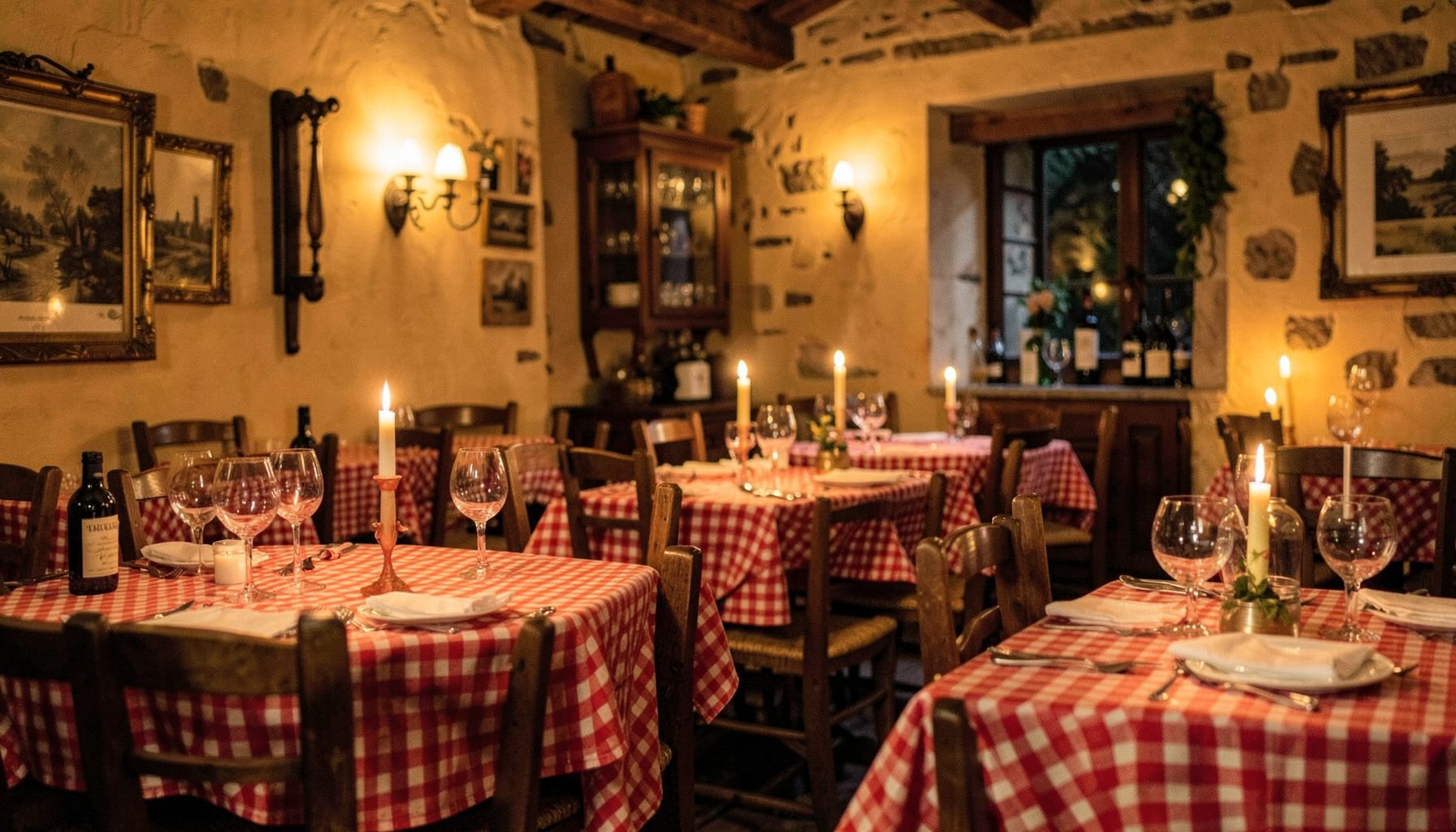
Some evenings the best seat in the house is the one furthest from the kitchen door. Our lounge was designed for long, unhurried evenings — low light, worn timber, the river running past the window — and it turns out to be an ideal setting for a first date as much as for a family supper. Come early in October, when the pears are still coming and the first pomegranates are on the bar.
Persimmons: Astringent, Silky and Always Ripening
The commonest misunderstanding about persimmons is that they are interchangeable. They are not. The flat, squat Fuyu — the one most Australians meet in the chilled aisle of Coles or Woolworths through the colder months — is edible firm, sweet and faintly spicy, with the texture of a ripe tomato. The elongated Hachiya, which looks like a small orange lantern, is a different proposition: unripe, it floods your mouth with tannin and puckers your lips for a quarter of an hour, and no amount of cooking disguises that. Left in a paper bag on the counter for three or four days, it turns to jelly, and then it is magnificent.
Between those two sits a family of smaller, sweeter fruit — Black Beauty, Rojo Brillante, the squat and lumpy Mabe — that the Italian growers we buy from favour, and that we like best of all. They are less uniform, more aromatic, and they hold their shape through heat, which matters when the next stop is the oven.
The lesson we repeat to staff is simple: ripeness is the whole game, and the only way to know is to touch it. A persimmon ready to eat gives gently at the shoulder and smells like ripe apricot and honey. One that still feels like a shop will punish you. That is why we buy in small quantities and twice a week, and why a hard persimmon rarely leaves our kitchen in front of a guest.
Pomegranates: Rubies Behind a Hard Shell
A pomegranate tells you almost nothing about its contents, which is part of the appeal and part of the frustration. The shell can be bright and taut or dull and leathery, and it can look identical either way. Weight is the reliable test: in the hand, a good one feels heavy for its size, as though the seeds have filled every cavity. Look for dry, uncracked skin, a flat crown rather than a swollen one, and no sign of mould or leaking juice at the base.
Inside, the fruit is a small architectural argument. The arils — each a bead of juice in a translucent sac — are what you eat; the pith between them is bitter and belongs in a molasses, not on a plate. The best fruit here arrives around the middle of October, and it arrives with real differences in character: the Spanish heirloom Grenats de Valence is tart and perfumed, the Wonderful is sweeter and more forgiving, the Israeli Hicollar is small, dense and intensely floral.
We use them three ways. Arils go onto the salad as a garnish and onto the charcuterie board, where their acidity cuts the fat. The juice goes into a reduced glaze that dresses duck or slow-cooked lamb shoulder. And the skins go into a pot, where they become the dark, tannic molasses that flavours a dessert we are quietly excited about this year.
Fire, Sugar and Acidity in the Sonoma Kitchen
Everything that happens to the fruit happens over fire. The persimmon, halved and still warm from the tree, goes onto the grill with a little salt and our own oil and comes back with a caramelised edge and a soft centre, dressed with sheep's cheese from the coast and toasted walnut. The pomegranate goes the other way: raw, bright, unaltered, so the plate keeps its sharpness.
The pasta course is where the two fruits meet. We fill ravioli by hand with ricotta, lemon zest and a whisper of nutmeg, and serve it with roasted persimmon, brown butter and sage — sweet against salty, warm against cool. It sounds like a dessert and eats like the first course of a winter meal. We also fold pomegranate molasses into a barbecue-style glaze for the wood-fired meats, and finish a plate of bitter leaves with both fruits at once, because persimmon and pomegranate in the same mouthful is the combination our regulars order for the rest of the year.
Wine is the quiet third ingredient. A grilled, savoury persimmon wants something with grip and earth — a Chenin Blanc from the Russian River or a Gamay from a cool Sonoma site. Pomegranate, with its tannin and acidity, is happy with a chilled Lambrusco or a young Tannat from the benchlands, and the fruit makes a red wine taste more like itself than almost anything else we could put on the table.
Serving Them: A Practical Guide for the Table
If you are buying your own, use this as a shortlist at the market and a second one at the table.
At the market or orchard stall:
- Weigh the fruit in your palm and compare it with its neighbours; the heaviest of a cluster is usually the ripest.
- Skip any pomegranate with a split crown, a soft patch or a bruise at the base.
- Fuyu persimmons are your friend if you want to eat one on the walk home; Hachiya needs a day or two on the counter first.
- Ask the grower when the fruit was picked rather than when it will be ripe — some orchards pick days ahead for shipping.
- Buy pomegranates in a quantity you will actually finish; arils keep five days, whole fruit two or three weeks in the fridge.
On the table at Taverna Santi:
- A ripe Hachiya, spooned out, with thick yoghurt and a dust of cinnamon.
- Grilled persimmon, still warm, with aged cheese, toasted walnut and a slick of olive oil.
- Pomegranate arls over bitter leaves, chicory and something salty from the charcuterie side.
- Pomegranate molasses poured over roasted pear or soft sheep's cheese.
- A whole pomegranate split at the table, so the guest does the work and the seeds end up in front of them.
From the Sonoma Valley to Australian Kitchens
Australians know these fruits better than the calendar suggests. Persimmons are grown commercially in Victoria's Sunraysia district, through New South Wales and along the subtropical belt of Queensland, and the Fuyu turns up in Australian supermarkets through winter — so an Australian autumn is spent eating persimmon cake, fruit salad and a salad of rocket, feta and persimmon that our kitchen now serves from October. Locally grown pomegranates arrive in the late summer months and run into autumn, while the winter fruit on the shelf has usually crossed an ocean from California or Iran. The difference shows: a fresh local pomegranate is brighter and more tart than an imported one.
There is also a fruit with a bad name to defend. Diospyros lotus, the native date plum, grows wild around Sydney and along the eastern coast, and Australians who pick it from a roadside tree often spit it out in disgust, because an unripe one is pure tannin. Let it fall from the tree on its own schedule and it turns sweet and edible — a small lesson about the persimmon family that applies in either hemisphere.
The markets tell the same story. Queen Victoria Market in Melbourne, the Central Market in Adelaide, the Sunday growers at Pyrmont in Sydney and the subtropical producers at Brisbane's weekend stalls all put the fruit out in its own season, and the Australian habit of cooking from what is good that week rather than from what is in the plan sits closer to how we cook in Geyserville than to how most restaurants operate. It may be why our guests from Australia keep ordering the persimmon salad.
Autumn arrives in Australia at the other end of the calendar, which is why we think about this fruit in September and serve it in October — the southern spring feels like an Italian autumn from the other direction. If you want to catch the season in its first week, or to plan a celebration around the private events and seasonal suppers we run as the leaves turn, reserve a table and tell us you are coming for the persimmon and the pomegranate. We will put them in front of you, over fire, with something cold to drink.